 Stay dry
Base layer
directly on the skin
- Material
- Merino or synthetic fiber
- Parts
- T-shirt and long underwear
- Never
- Cotton
Guides
Language
EnglishCurrency
US dollar · $GetYourGuide shows its prices in the currency you pick.
Guide · Clothing
When waiting for the northern lights you stand still in the cold for a long time. With the right clothing in multiple layers the evening stays enjoyable instead of a test of endurance.
Editorial rovaniemipolarlichter.deUpdated on October 3, 20266 min read5 sources
In short
When skiing or hiking you stay warm from the movement. When waiting for the northern lights it is the opposite: you stand still, look up and release heat to the air over a long time. Add in the time of day. The best window in Finland is mostly between nine p.m. and two a.m., right in the middle of the cold polar night.3
The numbers show how cold it gets. In winter the average temperatures in Rovaniemi are between minus 10 and minus 20 degrees.1 At the Rovaniemi Apukka weather station the average low in January is minus 17 degrees and in February minus 17.2 degrees.44 Individual nights can be significantly colder than this long-term average.
The good news: against this cold it is not expensive special equipment that helps but the right system. Visit Rovaniemi advises staying warm on frosty days with several layers of winter clothing.2 Between the layers air stays trapped and insulates, and you can open a layer as soon as you are in the warm vehicle and close it again when you go back outside.
Dress Up
At the hotel
Merino wool or functional fabric against the skin, plus thick wool socks.
Before setting off
Fleece or wool sweater, wear it open while you are still indoors.
At the door
Jacket, snow pants, hat, and scarf; Visit Rovaniemi recommends several layers.2
Outdoors
Thin gloves for handling, thick mittens for waiting.
Late in the evening
In Finland the northern lights usually appear between 9 p.m. and 2 a.m.3
The bottom layer decides the whole evening. It should move moisture away from the skin so you do not cool down in your own sweat. Merino wool works well, and synthetic base layers work too. Cotton is a no-go: it soaks up moisture, does not dry in the cold and pulls warmth from your body the moment you stop moving.
Wear a long top and long underwear, both fitting closely. If you get cold easily, combine a thin layer with a thicker one. The same applies to your feet: wool socks instead of cotton socks, and better one good thick pair than several pairs that squeeze your feet in the boot and restrict circulation.
Put on the base layer in the hotel and not just right before you head out. That way you start the evening dry and warm. In the vehicle you open the outer layers so you do not start sweating and close them again only when you go outside. Wet clothing in frost is the fastest route to a cold, uncomfortable evening.
Climate
Month by Month
| Month | Daytime high | Nighttime low | What you need |
|---|---|---|---|
| October | 3,7 °C | -2,1 °C | Warm jacket, hat, gloves |
| November | -1,7 °C | -7,8 °C | Full winter clothing |
| December | -4,9 °C | -13,2 °C | Winter clothing and heat packs |
| January | -7,4 °C | -17 °C | All layers, balaclava |
| February | -7 °C | -17,2 °C | All layers, balaclava |
| March | -1,1 °C | -12,9 °C | Winter clothing, sunglasses during the day |
Average daytime highs and nighttime lows at the NOAA Rovaniemi Apukka station, 1991 to 2020.444444
The layering system
Stay drydirectly on the skin
 Insulate
Hold in warmth
 Protect
Keep out wind and snow
Decision helper
When and how are you traveling?
The average low temperature in October is minus 2.1 degrees.4
Extra warmth for hands and feet and no gap between jacket and pants.
Thin gloves for operating the camera, thick mittens for the breaks.
An overall replaces the outer layer; you bring the base and mid layers yourself.
The weather in Rovaniemi is cold and clear! Stay warm on these frosty days by wearing several layers of winter clothing.
Over the base layer comes the insulation. A thick wool sweater, a fleece jacket or a light down jacket keeps your body heat in. It is not the material alone that matters but the air trapped between the fibers. Several thinner layers often keep you warmer than one single very thick layer, and you can add or remove them individually.
For the legs a fleece pair of pants or another layer of wool underwear under the snow pants is usually enough. Make sure nothing binds, especially at the waist and ankles. You feel cold first where the blood cannot flow freely, so in your toes and fingers, and that is exactly where it decides how long you want to stay outside.
The mid layer is the one you adjust most often. In the vehicle or in a warm cabin you open it, outside you zip it up again. A zipper all the way to the chin is more useful than any extra pocket. A collar that covers the neck can often save you from needing a scarf when the wind dies down.
Packing list
Video
The video only loads when you tap Play.
On the very outside you need protection from wind and snow. A insulated winter jacket that reaches past the hips and snow pants with a high waistband are ideal. Wind is especially unpleasant in standing cold because it carries the warm air away from your layers. A windproof shell noticeably boosts the effect of the layers underneath.
If you do not have your own winter gear, ask your accommodation or tour operator about rental clothing before your trip. The booking page of a tour will state whether winter clothing is included. The northern lights tour on this page does not mention winter clothing being provided. So plan your own equipment before you board the plane.
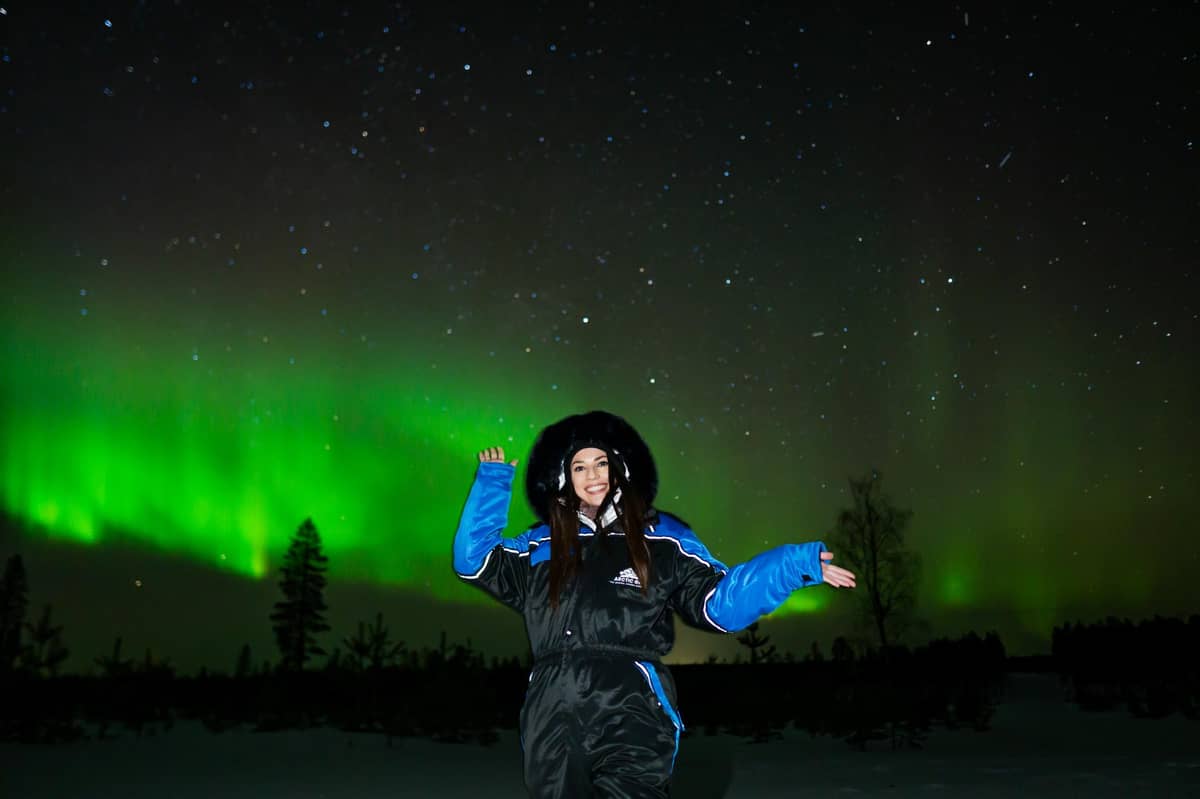
A one-piece overall keeps you especially warm because no gap forms between jacket and trousers. Even when you rent one, you still wear base and mid layers underneath. It replaces the outer layer, not the whole system. Make sure it is large enough so that the layers underneath are not compressed and can retain their insulating air.
Cold feet end a northern lights evening faster than anything else. You need winter boots with a thick sole that still leave enough room for wool socks. Shoes that are too tight are a common mistake, as they squeeze the blood out of your toes. Felt insoles or heat pads in the shoes provide extra help when you stand on snow or ice for a long time.
For hands, the mitten principle beats gloves. Thin liner gloves let you operate your phone or camera; over them you pull on thick mittens, which you take off again during the waiting time. With your fingers together inside mittens, they warm each other. A pair of heat pads in your jacket pocket is a cheap reserve for especially cold nights.
Without a hat, your head cools quickly, so a hat that covers your ears is always a must. A scarf or neck gaiter protects your neck and face from the wind. At very low temperatures, a balaclava is pleasant, leaving only your eyes free. Do not forget your headlamp, ideally with red light so it does not blind your eyes.
A common mistake is wearing too many layers in the wrong order. Anyone who wears several sweaters over a cotton base layer will sweat inside the vehicle and then freeze even more outside. Better a dry base layer, a targeted mid layer, and a windproof outer shell. Open a layer when you feel warm, rather than sweating it out and then cooling down.
Another mistake concerns your feet. New, unbroken-in boots pinch, and pinching shoes freeze your feet faster. Try on your boots before the trip with the wool socks you plan to wear in Lapland. If there is no room for your toes at the front, go one size up. Cold toes are hard to warm up again outside, but warm feet keep you out for a long time.
Finally, the cold on your face is often underestimated. Wind on the skin feels significantly colder at freezing temperatures than the measured air temperature. A neck gaiter you can pull over your nose and chin, and a rich cream for your lips and cheeks, will protect you. This way you can look up relaxed, without having to rush back to the vehicle after a short time.
For a winter northern lights trip, pack in layers: enough base layers to change, a warm mid layer, jacket, snow pants, boots, and hand and head gear. Rovaniemi sits on the Arctic Circle, and you will feel the winter cold there from the moment you arrive.5 Wear your boots and jacket already on your journey there.
If you are missing something on site, pick up small items like wool socks, gloves, or heat pads on your first day. But for the complete gear, preparation at home is worthwhile, because there you have time to try everything on and check the fit. So plan the basic system before your trip and only add what you truly miss after your first evening.
And finally: clothing is not everything. Hot tea from a thermos, a snack, and a bit of movement in between keep you warm as well. If you feel cold, tell your guide early instead of suffering in silence. A few minutes in a warm vehicle can often save the whole evening, and with a bit of luck the northern lights will still appear.
Book the tour
Reserve now, pay later, and cancel for free up to 24 hours before the start.
Several layers of winter clothing. Visit Rovaniemi recommends layers: wool against the skin, fleece on top, and a windproof jacket and snow pants on the outside.2
On average minus 10 to minus 20 degrees. These are average winter values according to Visit Finland; individual nights can be colder.1
Only with layers underneath. Without a base and mid layer, you cool down quickly in a simple jacket when standing for a long time.
Lined winter boots. With a thick sole and room for wool socks; shoes that are too tight make your toes freeze faster.
No. Cotton absorbs moisture and does not dry, merino wool or functional underwear is better.
The tour does not mention that it does. Plan your own clothing or ask before booking; the tour lasts eight hours.
Mittens over gloves. Thin liner gloves for operating, thick mittens over them for the waiting time.
Sources
Read more