 Mild
MildAutumn
September and October
- High
- 11.7 °C in September
- Sun
- 12.7 hours in mid-September
- Good for
- Reflections on the water
Guides
Language
EnglishCurrency
US dollar · $GetYourGuide shows its prices in the currency you pick.
Guide · Travel time
The season above the Arctic Circle is long, but each month has its own character. Here you can see how darkness, cold, and precipitation change across the winter, and which period suits your preferences.
Editorial rovaniemipolarlichter.deUpdated on October 3, 20266 min read10 sources
In short
There is no single best day for the northern lights over Rovaniemi, but a long season. Visit Rovaniemi describes it like this: it begins in late August and runs through the winter into early spring, until early April.1 For all of Lapland, Visit Finland names a similar period from late August to April.3 Within these months, it can glow on any clear, dark night.
Darkness is what determines these boundaries. In summer it does not get truly dark at the Arctic Circle, and the official midnight sun period in Rovaniemi runs from early June to early July.4 The northern lights are not gone then, but they are invisible against the bright sky. Only when the nights grow longer again in late summer does the time begin when you can look up.
For your planning, the key question is therefore not whether the northern lights are there, but which conditions you want. Do you want mild evenings, plenty of darkness, or a deep winter covered in snow? Each of these answers leads to a different part of the season. The following sections go through the months in order, with figures from the NOAA weather station Rovaniemi Apukka.
The Year at the Arctic Circle
End of August
The nights become dark enough again.1
September
Average daily high of 11.7 °C.2
December
On December 21 or 22, the sun does not rise at all.5
February
On average only 4 days with at least 2.5 mm of precipitation.2
Early April
After that, the nights get too bright.1
June to July
The sun does not set from early June to early July.4
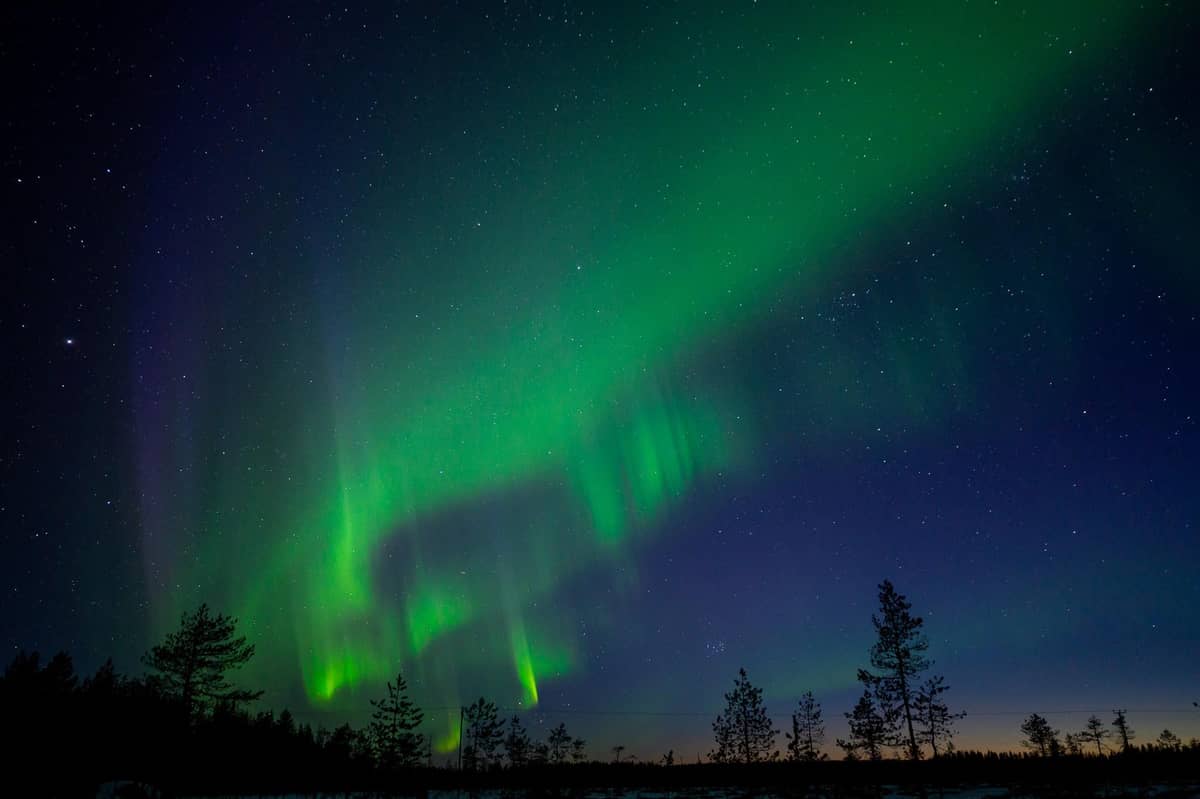
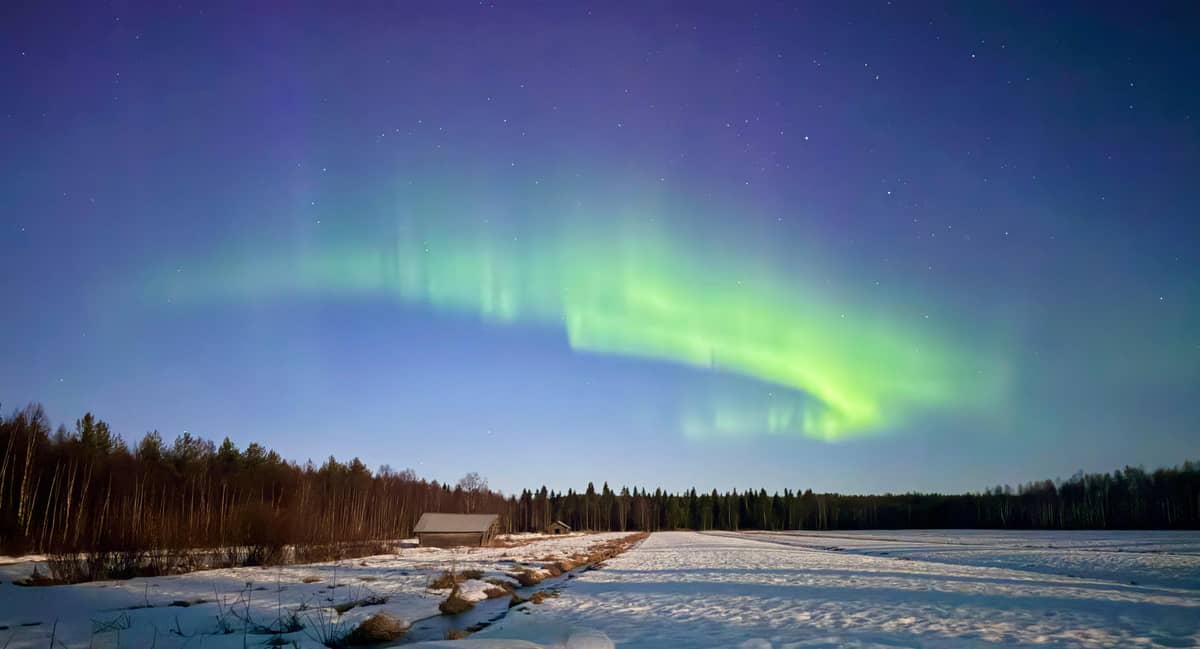
Autumn is the underrated season for the northern lights in Lapland. Visit Finland explicitly points out that you can already see them in August or September.3 The lakes and rivers are not yet frozen, and with a bit of luck the green glow is reflected in the dark water. Add forests that turn yellow and red before the first snow falls.
The temperatures are considerably more pleasant than in winter. In September the average daily high is 11.7 °C, in October it is still 3.7 °C.22 For an evening outdoors, a warm jacket and a hat are enough; you do not need gear for severe cold. Those who shy away from cold will find autumn the gentlest entry into the season.
The price for the mild evenings is shorter nights. In mid-September the sun is still above the horizon for 12.7 hours, in mid-October for 8.9 hours.22 It therefore only gets truly dark late in the evening. In addition, the station counts an average of 6 days with at least 2.5 mm of precipitation in both September and October.22 Plan for a few extra evenings in autumn.
Month by Month
| Month | Sun (h) | Without Sun (h) | High / Low | Precipitation Days | Northern lights |
|---|---|---|---|---|---|
| Jan | 3.5 | 20.5 | -7 / -17 °C | 6 | ja |
| Feb | 7.6 | 16.4 | -7 / -17 °C | 4 | ja |
| Mar | 11.1 | 12.9 | -1 / -13 °C | 4 | ja |
| Apr | 15 | 9 | 5 / -5 °C | 4 | until early April |
| May | 18.9 | 5.1 | 12 / 1 °C | 5 | no |
| Jun | 23.1 | 0.9 | 17 / 7 °C | 6 | no |
| Jul | 20.7 | 3.3 | 21 / 10 °C | 7 | no |
| Aug | 16.6 | 7.4 | 18 / 8 °C | 6 | from late August |
| Sep | 12.7 | 11.3 | 12 / 4 °C | 6 | ja |
| Oct | 8.9 | 15.1 | 4 / -2 °C | 6 | ja |
| Nov | 4.9 | 19.1 | -2 / -8 °C | 7 | ja |
| Dec | 0.9 | 23.1 | -5 / -13 °C | 6 | ja |
Sunshine hours at mid-month, temperatures as the average of daily highs and lows, precipitation days with at least 2.5 mm. NOAA 1991 to 2020.2 Season according to Visit Rovaniemi.1
Seasons compared
MildSeptember and October
 Long darkness
December and January
 Little rainfall
February and March
Decision helper
Choose what matters most to you on your trip.
The northern lights are best seen in Lapland and in the northern lake district of Finland from late August to April.
From November it gets dark quickly. By mid-month the sun shines for only 4.9 hours, and the station counts an average of 7 days with at least 2.5 mm of precipitation, as many as in no other month of the season.2 November is therefore long and dark, but also often overcast. Anyone traveling in this month should stay flexible and make use of every clear gap.
Anyone who wants to experience the northern lights in Rovaniemi in December gets the longest nights of the year. In mid-December the sun is above the horizon for an average of only 0.9 hours.2 On December 21 or 22, according to Visit Rovaniemi, it does not rise at all.5 During this polar night the city lies in blue and pink light at midday.7 It is dark enough to look up early in the evening.
December has another appeal: Advent at the Arctic Circle. The Santa Claus Village is on the Arctic Circle and is open every day of the year.6 A northern lights trip can be combined well with a visit there. Around Christmas it is worth booking accommodation and tours early, preferably with free cancellation, so you stay flexible.
Checklist
Video
The video only loads when you tap Play.
In January the light slowly returns. By mid-month the sun shines for 3.5 hours again, and the nights are still long.2 It is the coldest part of the year: the average low is -17 °C.2 This is exactly the charm of these weeks. The snow lies deep, the air is dry, and the landscape looks just as you imagine Lapland.
The northern lights in Rovaniemi in February have a practical advantage. The station counts an average of only 4 days with at least 2.5 mm of precipitation in this month.2 At the same time, by mid-month the sun already shines for 7.6 hours, so you can do plenty during the day and the nights remain long and dark.2 Anyone who wants to combine snow, cold, and daylight will find a good mix here.
The right clothing is important. Visit Finland gives average winter temperatures for Rovaniemi between -10 °C and -20 °C.8 On a northern lights tour you often stand still for a long time, and the cold then creeps quickly into fingers and toes. Several warm layers on top of each other are therefore more important than a single thick jacket. Our clothing guide goes into this in detail.
The northern lights in Rovaniemi in March benefit from stable winter weather. Even in this month the station counts an average of only 4 days with at least 2.5 mm of precipitation.2 The days become significantly longer: by mid-month the sun shines for 11.1 hours.2 But it stays dark enough in the evening, and the temperatures, with an average daily high of -1.1 °C, are milder than in January.2
March is therefore a good compromise. During the day you can enjoy the sun on the snow, try snowshoeing, or drive to the Santa Claus Village, and in the evening you go searching for the northern lights. The nights are shorter than in December, but Visit Finland anyway names the best window of a night as mostly between 9 p.m. and 2 a.m.9
Early April ends the season. By mid-April the sun already shines for 15 hours, and the nights become too bright.2 Anyone traveling in April should therefore come early in the month and not expect too much. For a pure northern lights trip, the weeks from September to March are the safer choice.
Besides the month, the time of night is the second factor. Visit Finland names as the best window of a night mostly the period between 9 p.m. and 2 a.m.9 The question of when the northern lights in Rovaniemi are most likely to appear can be roughly answered with this. But it is never certain: an aurora can appear earlier in the evening or shortly before morning and fade again after a few minutes.
Darkness shifts this window across the winter. In December it is already dark in the afternoon, in September only late in the evening. If you travel in autumn, you should plan for the second half of the window; if you travel in deep winter, you can start earlier. It is important that you do not spend the hours outdoors on an empty stomach and without a warm drink.
For all months, clouds matter more than the time of night. A clear night in October is more valuable than an overcast one in January. Therefore plan several evenings and check the cloud forecast every day. That way you choose not only the right month but also the right night.
When planning your trip, do not count on a single night. Visit Finland speaks for northern Finland of around 200 nights per year when the northern lights appear.10 Whether you catch one of them under a clear sky depends on the weather. With several evenings in Rovaniemi you spread this risk and have a real chance of seeing a strong display at least once.
A guided tour can help you salvage a cloudy night. The tour on this page is designed for a maximum of 8 guests, lasts 8 hours, and includes pickup. The guide drives to where the sky is open, and if necessary across the border. If the conditions make a northern lights sighting impossible, you get your money back.
Book early but flexibly for the high season around Christmas. With the tour on this page, you can cancel free of charge up to 24 hours in advance and reserve now, pay later. This keeps your choice of night open until you know the weather forecast for your travel dates. From $228 per person, you are in.
Book the tour
Reserve now, pay later, and cancel for free up to 24 hours before the start.
Late August to early April. During this time, the northern lights are possible in Rovaniemi.1 Which month fits best depends on your preferences.
In December. In mid-December, the sun is on average only 0.9 hours above the horizon.2
No. From early June to early July, Rovaniemi experiences the midnight sun.4 Against the bright sky, no northern lights are visible.
Yes, for mild nights. Visit Finland lists the northern lights as possible already in August or September.3 In September, the average daily high is 11.7 °C.2
Very cold. Visit Finland gives average winter temperatures in Rovaniemi between -10 °C and -20 °C.8
February and March. In both months, the station averages 4 days with at least 2.5 mm of precipitation.22
Not on December 21 or 22. On that day, according to Visit Rovaniemi, the sun does not rise at all in Rovaniemi.5
Sources
Read more